

George Daggett – Artisan
We have a terrific attraction on the west side of Denver in the foothills near Morrison called Dinosaur Ridge. It is a fascinating trek through time. One of my favorite features, along with the many dinosaur tracks, is the ripple rock. Ripple rock is sandstone with ripples left behind by an ancient sea bottom. After the seaway disappeared, the sandstone preserved the ripples. The sandstone has been pushed to a nearly vertical position by the uplift of the Rocky Mountains.
I recognized a big wall of ripple rock north of Dinosaur Ridge and just to the north of I-70. One weekend, I traipsed cross country to arrive at a quarry created by shale miners around 1900. The shale was in a thick seam, and the miners exposed the sandstone walls on either side of the seam when they removed the shale.
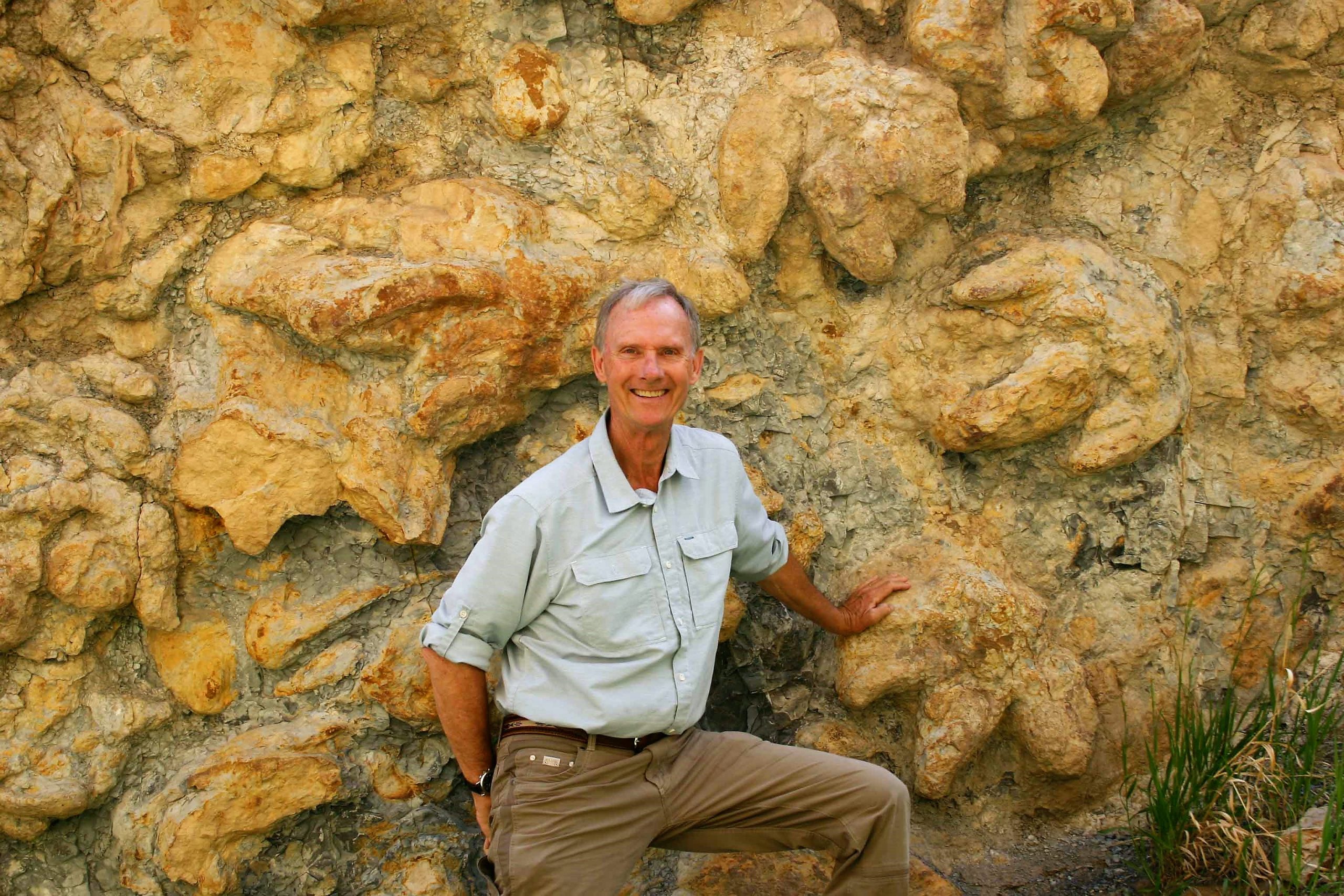
One weekend I was up there exploring and I came across a wall section that had all kinds of bumps on it. I said to myself, “What makes bumps?” Well I looked and I thought and I looked and I thought – and then I saw three toes! Yikerinos!!
I was looking at the underside of dinosaur tracks. Dinosaurs had walked in mud, which later became shale. Almost immediately, a whole flood of beach sand covered the mud and filled in the holes. This was all about 105 million years ago in the Late Cretaceous. Then the uplift of the Rocky Mountains about 65 million years ago turned the beach into a wall, and now we see the filled-in bottoms of the holes from underneath.
I reported the discovery to the folks at Dinosaur Ridge. They came up and confirmed that yes these were real dinosaur tracks probably made by Iguanodons. Their research showed that nobody else had reported them. So I got credit for discovering these dinosaur tracks. The site is called the Hawks Nest Site and is part of Dinosaur Ridge. Today, this area is designated the Morrison Fossil Area National Natural Landmark.